· 6 min read
Multi carrier shipping software: what to buy, and when to build
Multi carrier shipping software lets you compare rates, buy labels and track parcels from several carriers on one screen. Most small businesses should simply buy it: Pirate Ship has no monthly fee for UPS and USPS, Shippo has a free plan, and ShipStation starts at $14.99 a month. Build your own only if you run trucks, hubs or client reporting that those tools weren't made for.
What multi carrier shipping software does
If you ship with more than one carrier, you've probably had a tab open for each. These tools replace those tabs. The everyday jobs are the same across most of them:
- Pull in orders from your online store.
- Show the rates from each carrier, so you can pick on price or speed.
- Print labels one at a time or in bulk.
- Track parcels and handle return labels.
Many also sell discounted carrier rates. Shippo, for one, offers them on its free plan.
What the main tools cost in November 2026
These are monthly list prices from each company's own pricing page, checked on 3 November 2026. They change, so confirm before you sign up.
| Tool | Entry price | As you grow | Good to know |
|---|---|---|---|
| Pirate Ship | Free, with no monthly fee | Still free. You pay for labels | UPS and USPS only |
| Shippo | Free for up to 30 labels a month | Pro: $19 a month for up to 200 labels, $29 for 201 to 500 | Your own carrier account costs 5 cents a label on the free plan |
| ShipStation | Starter: $14.99 a month for 50 shipments | Standard: $29.99 for 50, $89.99 for 500 | Your own carrier accounts start on Standard. 30-day free trial |
On those prices, a US seller shipping UPS and USPS parcels should try Pirate Ship first. Shippo suits someone who wants more carriers at a low flat fee. ShipStation is the fuller tool, with more users and automations as you move up, and it covers 200+ parcel carriers.
How to choose shipping software for a small business
Skip the feature tables. These five questions will narrow it to one or two.
- How many parcels do you send a month? Prices step up by volume, so work out the plan you'd be on in a year.
- Are your carriers on the list? Check this first if you're outside the US, because the tools aren't equally strong everywhere.
- Do you have your own negotiated rates? Then you need a plan that lets you connect your own accounts.
- Which stores do you sell on? Make sure each one connects.
- How many people print labels? Some plans limit users. ShipStation's Starter includes 3, for example, and Standard 10.
Then ship a real day's orders on the free plan or trial. An hour of real use will tell you more than any comparison, this one included.
Plan the switch for a quiet week. Run the new tool next to the old one for a few days, print real labels on your real printer, and check that a tracking update reaches a customer. Connect one store first. If you've got negotiated rates, load them before you compare prices, or the tool will show you its own rates and the sums won't mean much.
Where these tools stop
These products are built for a seller shipping its own parcels. Things change when shipping is your business: a logistics company, a 3PL or a distributor with its own vehicles. On their pricing pages, we couldn't see these jobs covered in full:
- Your own trucks treated as a carrier, alongside partner carriers.
- A rate card that works out what you charge your own clients, by pin code and weight.
- Failed deliveries (NDR), returns to origin (RTO) and reverse pickups, counted per client.
- Cash-on-delivery money collected and remitted, tracked per client.
- A daily report for each client, in that client's own format.
- Your margin: what you charged against what each carrier cost, per order.
- Box-by-box scanning at hubs, and proof of delivery from your own drivers.
If that list sounds like your week, a label tool will only cover one small part of it. That's where a custom system starts to earn its cost.
What a custom system looks like: FMT
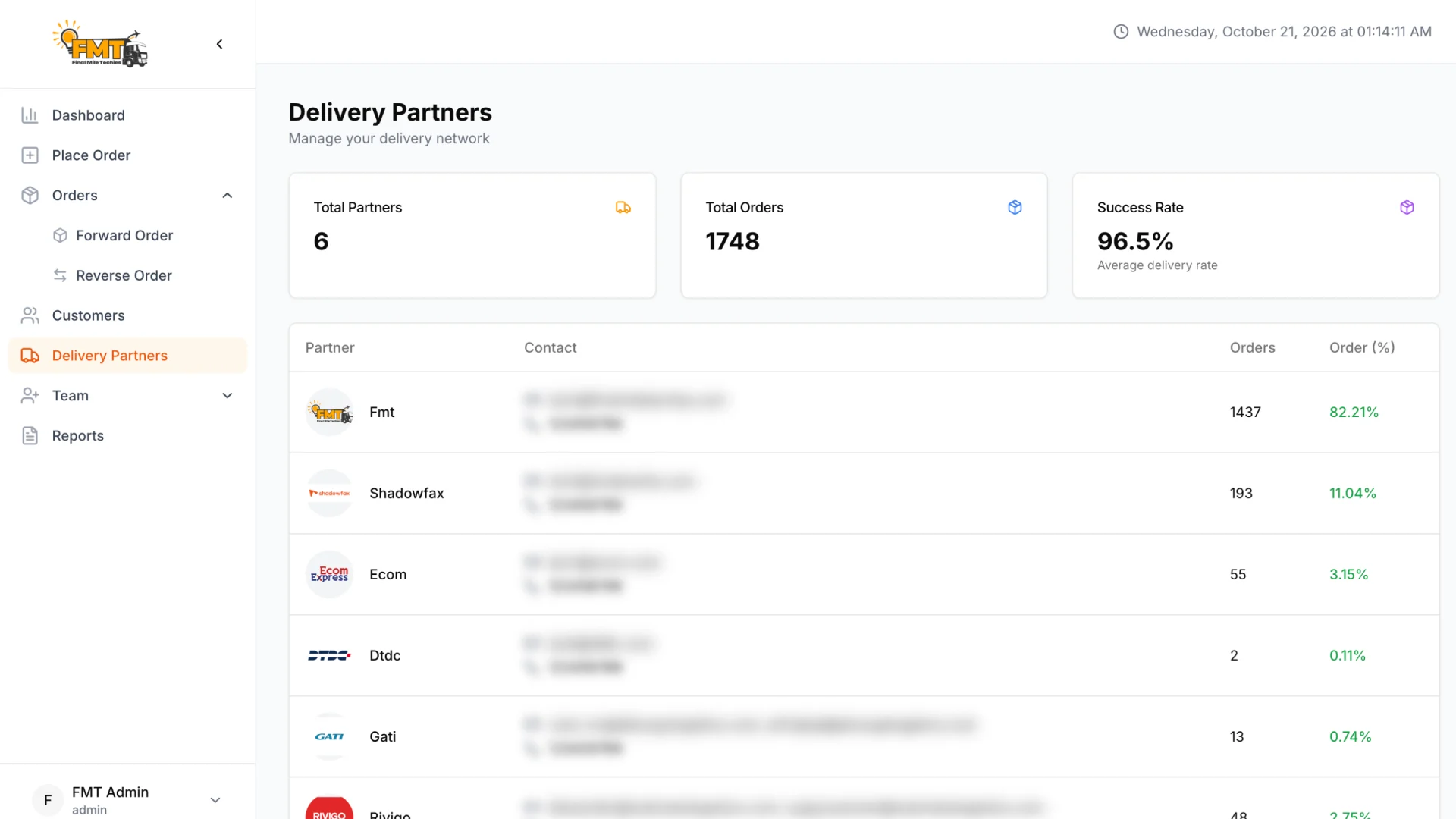
FMT is a logistics company in India with its own trucks and partner carriers. Every client asked the same thing: where's my order? The answer sat with FMT's trucks or with one of several carriers, each tracked its own way. Clients also wanted a daily report, proof of delivery and their cash-on-delivery money accounted for.
We built the whole flow in one system:
- Orders come in from FMT's team, CSV uploads, each client's panel, Shopify stores, Unicommerce and brands' own systems through an API.
- Each order gets a tracking number, an LR docket and labels. The team books FMT's own truck or a connected carrier: Rivigo, Gati, Shadowfax, Ecom Express or DTDC.
- Every morning the system finds orders not picked up within 24 hours and emails the carrier and FMT's admins.
- Carrier scans arrive on their own, and the customer gets a WhatsApp message when the parcel ships and when it's out for delivery.
- Every client gets an Excel report each day, with 17 columns in their own format. Nobody puts one together by hand.
- A handheld scanner app prints each carton's label over Bluetooth at the hub.

Logistics software
From the first order to the proof of delivery and the COD money, FMT's team and its clients work from the same record. 57% of orders went on FMT's own trucks (FMT's dashboard, 21 October 2026).2,500+orders tracked in one system<0.5%of orders returned: 5 out of 1,2732 yearsof automatic daily reports to every clientRead the case studyThe sums: buy, build, or a bit of both
If you're a store sending 500 parcels a month, ShipStation Standard at $89.99 a month comes to about $1,080 a year. Our business systems are $3,000 to $10,000, plus care from $1,000 a year. A custom system can't beat that for label printing, so don't build one for that job.
Custom pays off when the software is the business: when it saves staff hours every day, keeps clients, or shows you which carrier is losing you money. A system like FMT's, with several apps and carrier connections, is a full platform, which starts from $10,000 with us.
There's a middle path that most people miss. Keep the tool you have and build only the missing piece. ShipStation's Standard plan includes its shipping API, so your data can flow out. One tool, like a daily client report, starts from $1,500. We do the same for forwarders: tools around CargoWise, with no replacement needed.
Questions
Is there free multi carrier shipping software?
Yes. Pirate Ship has no monthly fee and covers UPS and USPS. Shippo has a free plan for up to 30 labels a month. You still pay for the labels.
What is the best shipping software for a small business?
For a US seller using UPS and USPS, start with Pirate Ship. If you need more carriers, try Shippo. If you need automations and several users, try ShipStation.
Can I use my own carrier rates?
Usually. Shippo allows it on every plan, with a 5-cent label fee on the free plan. ShipStation includes it from the Standard plan.
When does a business need custom logistics software?
When shipping is the business itself: your own trucks, hubs, COD money, or reports for each client. For printing labels for your own store, buy a tool.
Related work and pages
Sources
Every outside fact above was checked on 3 November 2026. Prices and rules change, so confirm them before you decide.