· 9 min read
MVP development cost: what a first version really costs
An MVP is the smallest version of a new product that real customers can use. Agency guides quote anywhere from $5,000 to $150,000 for one, which is too wide to plan a budget around. With us, a first version that does one job starts from $1,500, and a full working product, built end to end, costs $3,000 to $10,000, at a fixed price. Leaving features out is what brings the price down.
What an MVP is, and what it isn't
MVP stands for minimum viable product. It's the first version of a new product that does one main job well enough for strangers to use, and to pay for if that's the plan. Its purpose is to find out whether people want it before you spend the rest of your money.
Three things often get called an MVP and aren't one:
- A clickable design. It's useful for showing people the idea, but nobody can sign up and use it. That's a prototype.
- The full product with every feature half done. A first version should do less, and do it properly.
- A demo that only works on the founder's phone, with made-up data.
A simple test for the kind of MVP this guide prices: can a stranger sign up and get the main job done without you in the room? If they can, you have an MVP.
What an MVP costs
Here are our fixed prices, by the shape of the first version. They're launch prices for our next 5 projects.
| First version | What it usually has | Price |
|---|---|---|
| One job, one kind of user | An order tracker, a quote tool, or a simple web app that does one thing | From $1,500 |
| A full working product | End-to-end software: logins, payments, a panel for your team to run it, and AI where it helps | $3,000 to $10,000 |
| Several apps on one system | Several apps and systems working together, with AI, dashboards and connections to the tools you already use | From $10,000 |
Aim to fit your first version in one of the first two rows. The price is fixed in writing before we start, with a go-live date, and you pay nothing up front.
Agencies quote much wider ranges. One 2026 guide puts MVPs at $5,000 to $150,000, another at $10,000 to $50,000 and up. Ranges like these usually start from hours multiplied by a rate. Clutch's pricing guide shows typical rates of $50 to $99 an hour for firms in the US, and $25 to $49 in India. At $75 an hour, a 400-hour build is $30,000, and on hourly billing the total moves every time the hours do.
Hiring is the other route. The US median wage for a software developer was $135,980 in May 2025, and a first version needs design, the app itself, the server and testing. That is a lot to ask of one hire.
What moves the price of an MVP
Founders often expect the number of screens to set the price. These six things matter more.
- How many sides it has. A marketplace has buyers and sellers, so it's two products' worth of screens and rules. Start with the side that's harder to win.
- Money moving through it. Taking a card payment is simple. Holding money, splitting it or paying out sellers is a much bigger job.
- A phone app or a web app. A web app works on any phone and needs no store. A phone app in the app stores needs a developer account, and a new version usually goes through store review.
- AI and voice. Zibber hears every turn in your language and in English at once, and speaks its replies sentence by sentence. That was the product, so it had to be in version one. In most first versions AI is one feature among several, and a simpler version will do.
- Outside services. Each payment provider, map, calendar or messaging service adds work, and the risk that it changes under you.
- How settled the idea is. Changing the main flow halfway through is expensive. Write it down before anyone starts.
What to cut from version one
The big savings come from leaving whole features out. Trimming every feature a little saves less. Good things to leave for later:
- Separate iPhone and Android builds. One build can run on both phones, or you can launch as a web app.
- A second kind of customer. Win one side first.
- Admin screens for rare jobs. Refunds, edits and approvals can be done by hand for the first few months.
- Settings, profiles and themes. Nobody signs up for those.
- Your own reports. A weekly export to a spreadsheet tells you enough at first.
Keep these, even on a small budget:
- The main job, done properly. It's the thing you're testing.
- Safe logins, data and payments. A leak in the first month can end the product.
- A way to see what people do in it, so the launch teaches you something.
- A way for users to reach you when something goes wrong.
A real first version: Zibber
Zibber is a language app for Indian families. Its users are parents 50+ who would rather talk than read, tap and type, and many have never used a chatbot. We built it for its founder, from the first screen to beta.

Voice AI app
An iPhone app you tap and talk to. It answers out loud in Hindi and 8 more Indian languages, and adds English a little at a time.9Indian languages, plus English50+the age of the parents it's built forBetaon TestFlight with real familiesRead the case studyHere's what went into the first version:
- One build for both phones. Zibber was built once for iPhone and Android, with no separate Android app to pay for. The beta is running on iPhone first.
- The main job, done fully. You tap and talk, it hears you in your language and in English at once, and it speaks its replies sentence by sentence.
- A first minute with no forms to fail. Pick your language, your goal and your daily time, then start talking.
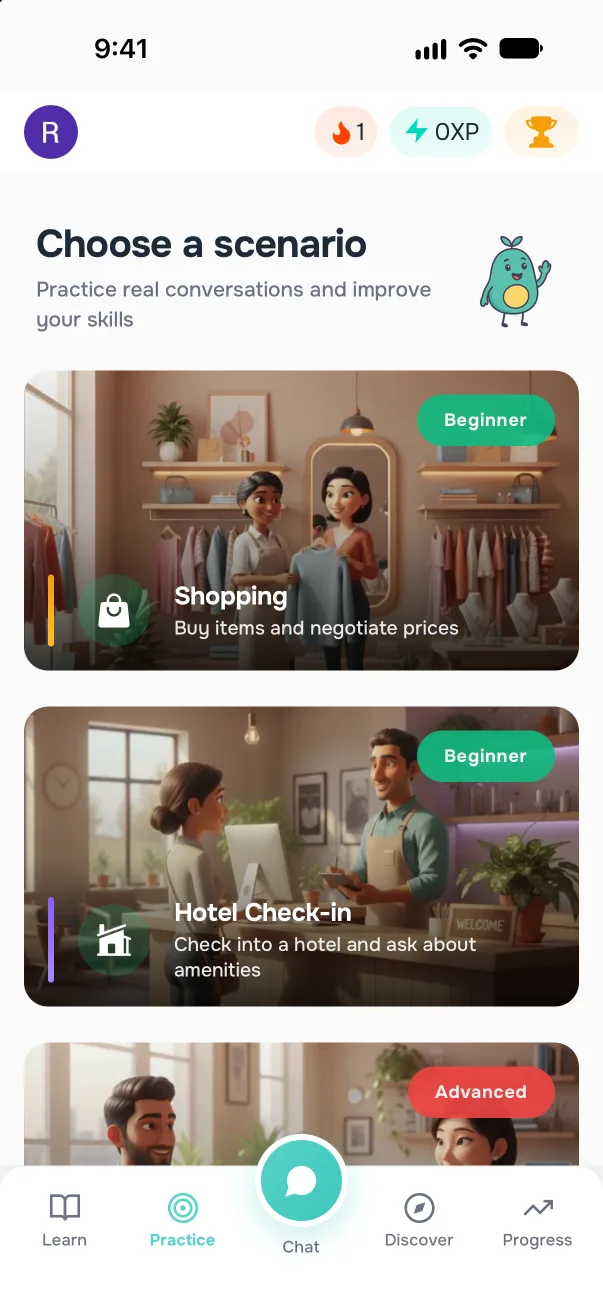
- Reasons to come back: lessons, 8 real-life practice scenarios, audio stories, streaks and a weekly leaderboard.
- Real users before launch. It's in beta on TestFlight with real families, so the founder can learn from them first.
Apple's TestFlight lets you invite up to 10,000 outside testers to a beta. That's plenty to learn from before a public launch.
The bills after launch
The build is a one-time fee. The spending then carries on after launch day. These are the costs a first version usually has, checked on 18 November 2026.
| Cost | What you pay | Notes |
|---|---|---|
| The build with us | One time: from $1,500 for one job, or $3,000 to $10,000 for a full working product, end to end | A fixed price. Nothing up front, half after the first working part, the rest at go-live |
| Apple Developer Program | $99 a year | If you're on iPhone. A company account needs a D-U-N-S Number |
| Google Play account | $25, once | If you're on Android |
| Store commission | 15% on Apple's Small Business Program, if you qualify and enrol. Google's fee depends on the market and how you bill | On paid apps, and on digital goods or subscriptions sold in the app |
| Hosting and database | Included in care with us. On your own, for example, Supabase Pro from $25 a month and Vercel Pro from $20 a month | Supabase pauses free projects after a week without activity |
| Text messages | $0.0083 per message segment to US numbers on Twilio, plus carrier fees. A long text can be more than one segment | Login codes by text add up as you grow |
| $0.10 per 1,000 on Amazon SES when you pay per email | Sign-up emails, receipts and reminders | |
| AI usage | $2 per million tokens in and $10 per million out for Anthropic's Claude Sonnet 5.5 | A token is a small piece of a word. The bill grows with every conversation |
| Care with us | From $1,000 a year (about $83 a month) | Hosting, database, monitoring and fixes |
| New features with us | From $500 each | A fixed quote before we start |
Two of these catch founders out. AI usage grows with every conversation, so work out the cost per user before you launch. And at the prices above, one text message costs about 83 times as much as one email, before the carrier fee. Sending login links by email keeps that bill small.
With us, care covers the server, monitoring and fixes. AI usage and paid outside tools are billed at cost, and we estimate them before you start, so your plan shows the running costs as well as the build price.
How to compare MVP quotes
Send every builder the same one-page brief: the main job, who uses it, which phones, the outside services it connects to, and the date you need it. Then ask each of them the same five questions.
- Is this a fixed price or an estimate? With an estimate that has no cap, you pay for the guess if it's wrong.
- What's left out? Look for design, testing, store submission and help at launch.
- When do I see something working, and how? Ask for a link you can open and try.
- What will I pay each month after launch?
- Whose name will the store accounts, the domain and the hosting be in?
Be careful with a quote that has a price and no feature list, or a feature list and no date. A low number with nothing written about what's left out tends to grow once work starts.
How not to pay for a half-finished build
The worst outcome is spending most of the budget on an app nobody can use. A few habits prevent it.
- Tie each payment to a working part you can open and use.
- Keep the accounts in your name from day one: the Apple and Google developer accounts, the domain and the hosting.
- Ask for a working link every week or two, on the phone you'll launch on.
- Write down what done means for each part before work starts.
Our own terms work the same way. You pay nothing up front, half after you've seen the first part working, and the rest at go-live.
Built a first version yourself in Lovable, Bolt or Replit and got stuck? Finishing what you have can cost less than starting again. If you're not technical, our page for non-technical founders shows how we take an idea from plain words to a first version.
Questions
How much does an MVP cost?
With us, a first version that does one job starts from $1,500, and a full working product, built end to end, is $3,000 to $10,000, at a fixed price. Agency guides quote anything from $5,000 to $150,000.
How long does it take to build an MVP?
It depends on the size, so get a go-live date in writing before you start. Our plans include one. Bigger builds take longer: Digidukan's apps, website, panel and backend went from start to live in five months.
Can a non-technical founder build an MVP?
Yes. You don't need to write code, but you need to know the one job it does and who it's for. Tell a builder that in plain words, and ask to see it working before you pay.
What's the difference between a prototype and an MVP?
A prototype shows the idea, usually as a clickable design, and it can't do the real job yet. An MVP is a working product that real customers can sign up to and use.
Do I have to pay up front?
Not with us. You pay half after you've seen the first part working, and the rest at go-live. With anyone else, try to tie each payment to something working that you can open.
Related work and pages
Sources
Every outside fact above was checked on 18 November 2026. Prices and rules change, so confirm them before you decide.
- Clutch: software development pricing guide, updated 21 September 2026
- US Bureau of Labor Statistics: software developers, May 2025 wage data
- Tekrevol: MVP development cost in 2026, an agency guide, updated 19 August 2026
- RaftLabs: MVP development cost, an agency guide, 2 July 2026
- Apple: Apple Developer Program enrollment
- Google: Play Console registration
- Apple: App Store Small Business Program
- Google: Play service fees
- Apple: TestFlight
- Supabase: pricing
- Vercel: pricing
- Twilio: SMS pricing in the United States, current as of November 2026
- Amazon Web Services: Amazon SES pricing
- Anthropic: Claude API pricing