· 6 min read
Restaurant loyalty program: how to set one up that pays
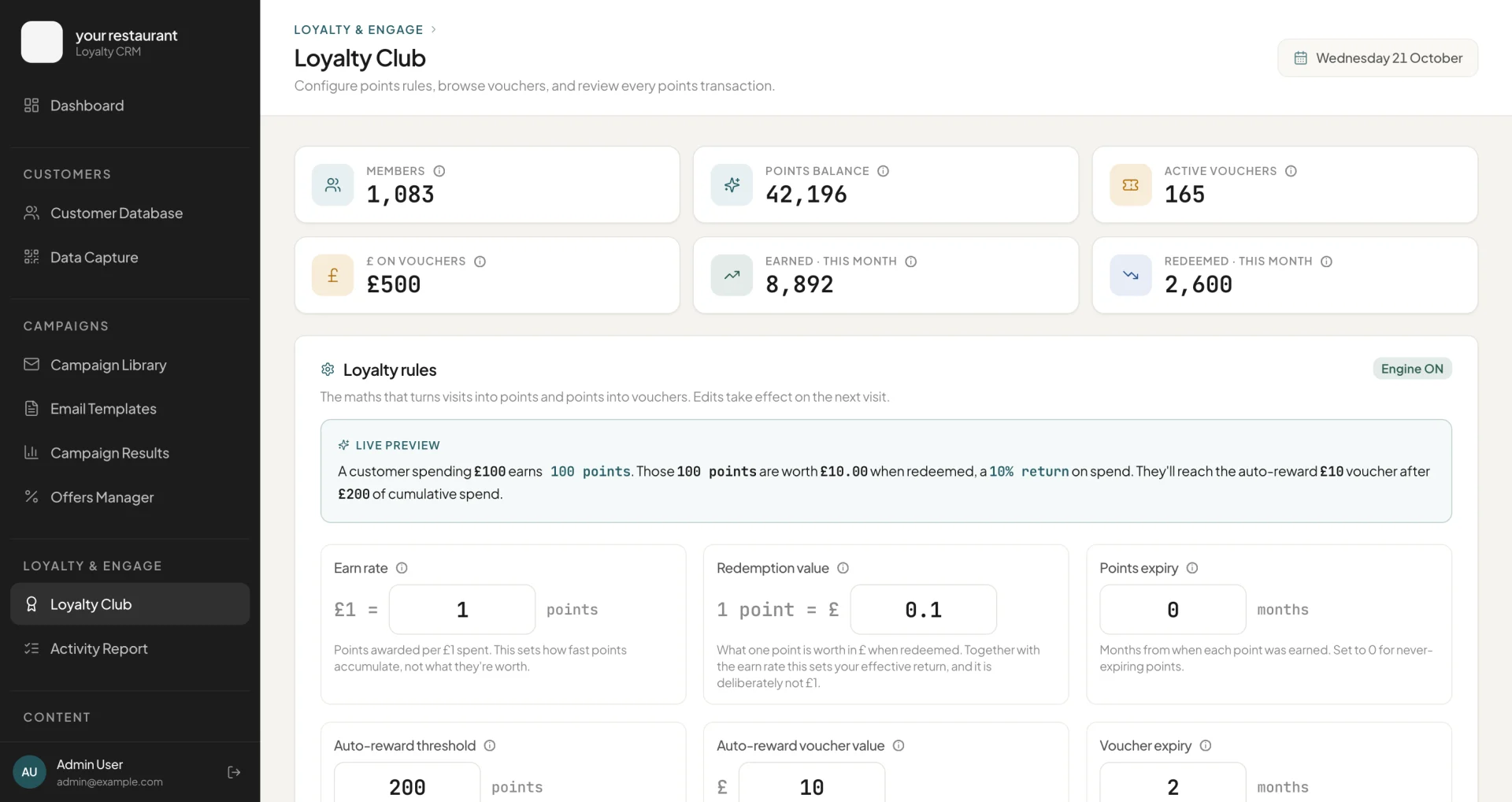
A restaurant loyalty program gives regulars a reason to come back: they earn points or stamps on each visit and swap them for a reward. A simple setup that works is one point per pound and a £10 voucher at 200 points, with an email when a regular stops coming. That's the setup we built for a UK restaurant chain on Pluzo, which now holds 4,400+ guests.
The four types of restaurant loyalty program
Pick the one your staff can explain in a sentence. If it takes longer than that, guests won't join.
| Type | How it works | Best for | Watch out for |
|---|---|---|---|
| Points | Guests earn points per pound or dollar spent | Sit-down restaurants, where spend varies | Needs a system to track balances |
| Stamps | Buy nine, get the tenth free | Cafes and takeaways with one main item | Rewards the visit, so big spenders earn no more |
| Tiers | Regulars climb to better rewards | Chains with many frequent guests | Harder to explain and to run |
| Paid membership | Guests pay for lasting perks | Places with very loyal regulars | Guests have to feel they're getting more than they pay |
Points are the safe default for most restaurants. They scale with spend, and you can run offers on top, like double points on a quiet Tuesday.
What to give away
Start from the numbers. On Pluzo, guests earn one point per pound, and 200 points issue a £10 voucher. That's 5% of spend back in vouchers. Your real cost is lower, because a £10 voucher buys £10 of food at menu price, and some vouchers are never used.
Then check how long a reward takes. Take your average spend per guest and divide. If a guest spends £30 a visit, 200 points takes about seven visits. For a place people visit monthly, that's most of a year, and they may lose interest. Lower the bar until a regular can reach it in a few months.
- Make the first reward quick. A small bonus on joining gets people started.
- Give an offer that brings a visit, like a voucher with an end date, and avoid plain discounts on a full Saturday night.
- Set rules for dates when offers don't apply, so you aren't paying for busy nights you'd fill anyway.
- Decide when points expire, and tell guests before it happens. A reminder is also a reason to visit.
Make it easy to join and easy for staff
Most programs succeed or fail at the table. If staff are too busy to ask, or joining takes three minutes, nobody signs up. Guests can join Pluzo on the restaurant's website, in the guest app, through a QR code or link, or at the table with staff. They become members straight away and get their login by email.
Does every restaurant need its own app? No. A small place can run on a QR code and a web page. A guest app earns its keep once you have enough regulars who want to check points and vouchers themselves. Pluzo has one on the App Store and Google Play because a whole chain's guests use it.
On the staff side, keep it to a few taps. In Pluzo, staff find the guest, enter the spend and pick lunch or dinner. At 200 points the voucher is issued on its own and emailed with a barcode. Pluzo's staff enter the spend themselves on a phone or web page. Linking to your till saves that step, and it's a question to ask any software seller.

Loyalty app
Points used to sit in an old checkout system, and guest details in an old CRM and a monthly spreadsheet. We built one system for all of it, with a staff app and a guest app.4,400+guests moved into one system600+members moved over, every balance exact3apps on one system: panel, staff app, guest appRead the case studyBring back the regulars who stopped coming
A points card only helps people already in the room. Your list does the rest, if you use it. Pluzo's saved searches find guests like “not visited in the last 90 days”, and those drive win-back offers. A voucher from a “Miss you” campaign was redeemed at the counter. Birthday, partner's birthday and anniversary emails go out on their own at 9:00 UK time.
Email is cheap to send. Pluzo sent 20,970 emails in August 2026. At Amazon SES's list price of $0.10 per 1,000 emails, that volume would cost about $2.10 before any extras.
Don't trust the open rate, though. Apple's Mail Privacy Protection downloads email content in the background whether or not someone reads it, so a machine can look like a reader. We split those machine opens from real ones in Pluzo, so the number means something. If your tool can't do that, judge a campaign by vouchers redeemed.
The rules on guest emails
A loyalty program is a marketing list, so the marketing rules apply. This is a summary, not legal advice.
- UK: to email customers without separate consent, you need the ICO's soft opt-in. You must have collected their details during a sale, market only your own similar products, and give a simple opt-out at sign-up and in every message.
- US: the FTC's CAN-SPAM guide says marketing emails need a valid postal address, and opt-outs must be honoured within 10 business days.
Build this in from the start. Pluzo records consent for each channel with its time and source, has a one-click unsubscribe, and opts out bounces and complaints on its own.
Buy loyalty software or build it
Most restaurants should buy. If you're already on Square, Square Plus includes a loyalty program that connects to your POS, and you can try it free for 30 days. Check Square's site for the current plan price. Toast and other restaurant systems sell loyalty too. Using the one built into your till means less training and no double entry.
A system of your own makes sense in a narrower set of cases:
- You've outgrown an old system and need to move members without losing a point.
- You run several sites, and want one guest list and one set of rules across them.
- Your rewards don't fit a standard tool, like complimentary vouchers, vouchers for non-members or date rules.
- You want to stop paying for parts you don't use, and keep the guest list in your own hands.
That was Pluzo. Points, members and everyone else sat in three places. 4,400+ guests and 600+ members moved over, synced again before the switch, and every point total matched exactly. For the cost side of that decision, see our build vs buy guide.
What to measure
Four numbers tell you if it's working. Check them monthly.
- How often members come back, compared with before they joined.
- How many vouchers are redeemed, and which offers brought them in.
- How many lapsed guests returned after a win-back offer.
- What the program costs you: vouchers redeemed, software and sending.
Questions
What is a good loyalty program for restaurants?
One your staff can explain in a sentence and guests can reach in a few months. Points are the safe default: one point per pound and a £10 voucher at 200 points gives back 5% of spend.
Do I need a restaurant loyalty app?
Not at first. A QR code and a web page can run a small program. A guest app makes sense once enough regulars want to check their own points and vouchers.
Can I move my members from an old loyalty system?
Yes, if the old system lets you export or read its data. For Pluzo we moved 600+ members, and every balance matched to the point.
How much does a restaurant loyalty program cost?
Your main cost is the rewards themselves. Add software, which can be part of your till plan, and email, which is cheap to send. A custom system starts in our business system range, $3,000 to $10,000, and with its own apps it's a full platform, from $10,000.
Related work and pages
Sources
Every outside fact above was checked on 3 November 2026. Prices and rules change, so confirm them before you decide.